The diamond is regarded as one of the hardest and most valuable minerals in nature, and its formation depends on very special geological conditions that take millions of years. Deep in the Earth's crust, carbon atoms are squeezed under high temperature and high pressure and, over time, form an orderly crystal structure. This crystal structure is the foundation of the diamond. It gives the stone both its durability and its ability to bend light. Diamond formation is considered an important natural event for understanding the Earth's interior and its geological processes.
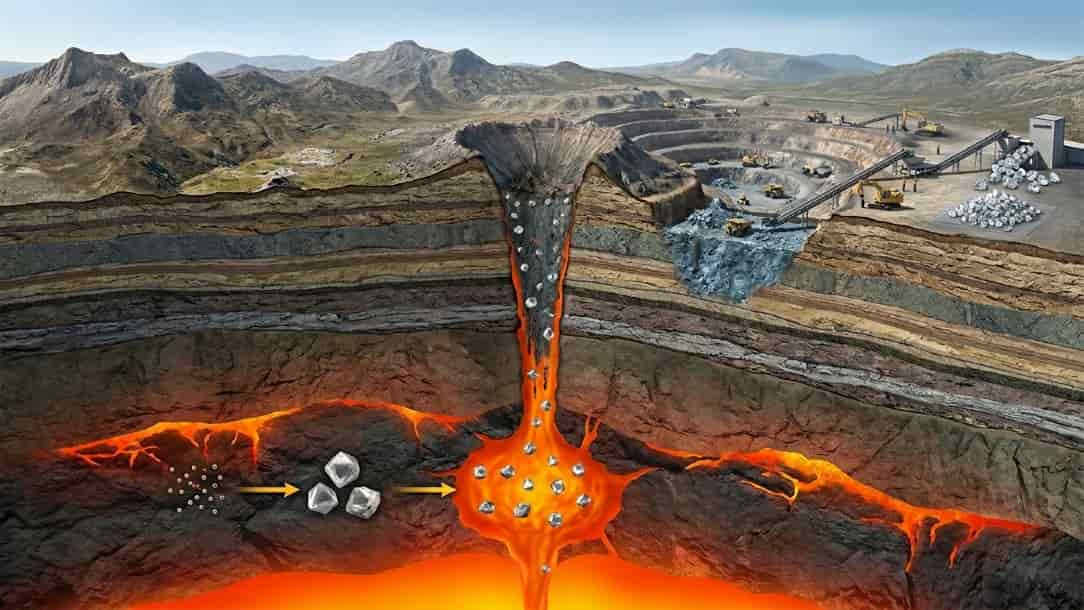
Diamonds form far below the surface, at a depth of roughly 150 to 200 kilometers. In these regions the temperature is very high and the pressure is extremely intense. Under these extreme conditions, carbon atoms build a highly ordered crystal lattice instead of a random structure. The lattice grows over time and forms the diamond. The diamonds are later carried toward the surface by volcanic activity, where they become accessible.
The diamond stone is the best-known natural form to come out of this long geological process, and it represents the result of the transformation underground reaching the surface. At this stage the crystal structure of the carbon is completely fixed, and the stone becomes highly resistant to outside influences. Because of this, the diamond attracts great interest for both scientific and aesthetic reasons, and it is considered one of the most special examples among natural stones.
The balance of pressure and temperature in nature plays a major role in diamond formation. The way carbon atoms bond to each other is the most important factor in the hardness of the stone. This structure makes the diamond one of the hardest natural stones to scratch. The ability to bend light also comes from the regular arrangement of this crystal structure.
Natural stone is the general name for minerals formed in the Earth's crust through long geological processes, and the diamond stands out as one of the most valuable examples in this group. Other natural stones take shape through different elements and environmental conditions, while the diamond forms entirely from carbon turning into a special crystal structure. For this reason, both its rarity and the length of its formation set it apart from other natural stones.
After the diamond reaches the surface, it is brought into human use through mining. However, there is a big difference between the raw form and the finished form. In nature it looks irregular and matte, while the finished stone, with its ability to reflect light, takes on a much brighter look. This transformation is one of the key stages that determine the value of a diamond.
In general, diamond formation is the result of a complex natural process that begins in the deep layers of the Earth and lasts millions of years. When the crystallization of carbon combines with the balance of high pressure and temperature, the result is a structure regarded as one of the most remarkable formations in nature, for both scientific and aesthetic reasons.
Related content: Materials needed to make jewelry at home
Do Diamonds Come From Coal?
It is a common belief that diamonds and coal come from the same source, but the two form through very different processes. Both are based on the element carbon, but the conditions are completely different. Coal forms in regions close to the surface, when plant remains are compressed over a long time. Diamond forms much deeper and under much higher pressure.
The environments where coal is found cannot reach the extreme temperature and pressure that diamond formation requires. For this reason, coal turning directly into diamond is not considered something that happens in natural processes. Still, the fact that both contain carbon is why people often link the two.
What Are Diamonds Made Of?
The diamond is a mineral made entirely of the element carbon. Under high pressure and temperature, carbon atoms form strong bonds in four directions and build a three-dimensional crystal structure. This structure gives the diamond both its hardness and its durability.
Natural diamonds can sometimes contain very small amounts of other elements. These elements can affect the color of the diamond and create different appearances. The basic structure, however, is always a carbon crystal.
Diamond formation is the result of the balance of energy and matter in nature. When carbon deep in the Earth's crust stays under high pressure and temperature for a long time, it tends to turn into the most stable crystal structure. This transformation can take millions of years.
In this process the carbon atoms settle into a more ordered structure and reach a stable form. The diamond is regarded as the most ordered and most tightly bonded form of carbon in nature. Its formation is therefore seen as the result of natural physical processes.
Diamond formation begins deep in the Earth's crust and continues as the diamond is carried to the surface. Carbon atoms in the mantle layer crystallize under high pressure and form the diamond structure. This process takes a long time and requires stable geological conditions.
The diamonds are later carried to the surface through special rocks called kimberlite. These rocks are deep-origin formations created during volcanic eruptions, and they are what bring the diamond to the light of day.
What Element Are Diamonds Made Of?
The basic building block of the diamond is the element carbon. Carbon atoms form strong covalent bonds and build a three-dimensional crystal network. This network is the main reason for the diamond's extraordinary hardness.
Only certain geological conditions are enough for carbon to take on this special structure. For this reason, the diamond is among the rare and valuable minerals found in nature.
The diamond is a natural mineral formed when the element carbon crystallizes under high pressure and temperature. This process takes place deep in the Earth's crust and can last millions of years.
The formation of the diamond is one of the most remarkable transformations in nature. This mineral, which comes about when carbon atoms settle into an orderly structure, attracts great interest for both scientific and aesthetic reasons.
Although it is often said that coal turns into diamond, this transformation does not happen directly in natural processes. Coal forms in regions close to the surface, while diamond forms in much deeper layers.
The fact that both are based on carbon looks like a similarity, but their formation environments and processes are completely different. For this reason, coal is not considered a direct stage in the formation of a diamond.
Natural diamonds form deep in the Earth's crust under high pressure and temperature over millions of years. Under these conditions, carbon atoms build a crystal structure and form the diamond.
The diamonds are later carried to the surface by volcanic activity. Because this process happens very rarely, natural diamonds are considered valuable. This special process in nature makes the diamond unique for both scientific and aesthetic reasons.
Diamonds do not form on any particular continent. They form deep in the Earth's crust. However, the regions where they are mined are concentrated on some continents. Africa, northern Asia, North America and Australia are known for their diamond deposits. The old and stable crust in these regions has geological features that make it easier for diamonds to be carried to the surface. The formation of a diamond depends not on the continent but on the mantle layer deep in the Earth.
How Many Facets Does a Diamond Have?
A diamond has no facets in its natural state. Facets are created by cutting the stone when it is made into a gem. In finished diamonds called brilliants, surfaces are cut at specific angles to increase the bending of light. The number of these surfaces changes with the cutting style, and it is decided entirely by human craftsmanship.
How Many Carbon Atoms Is a Diamond Made Of?
A diamond is not made of a structure simple enough to be given as a single number. It forms when carbon atoms build a continuous three-dimensional crystal lattice. In this structure each carbon atom bonds to four other carbon atoms, forming an endless network. For this reason, a diamond cannot be reduced to a specific number of atoms.
A diamond is a carbon crystal found in its raw state in nature. A brilliant is formed when this raw diamond is cut, polished and shaped. Its value as a gem comes entirely from craftsmanship and from improving how it reflects light. In other words, a brilliant is a natural diamond that has been worked by human hands.
Diamonds form deep underground when the element carbon crystallizes under high temperature and pressure. This process can take millions of years, and the crystals are later carried to the surface by volcanic activity.
Diamonds form when carbon is squeezed deep in the Earth and turns into a crystal structure. High pressure and temperature are the basis of this process, and over a long time a natural diamond comes into being.
Diamonds form deep in the Earth's crust, but after being carried to the surface they are found in certain regions. Africa, Russia, Canada and Australia are the best-known diamond mining regions. These areas are geologically old and stable.
Diamond formation does not depend on a fixed length of time, but it is a process that lasts millions of years. The crystallization of carbon takes place over very long periods, depending on how steady the underground conditions stay.
What Are Diamonds Made Of?
The diamond is made entirely of the element carbon. Carbon atoms form strong bonds and build a three-dimensional crystal structure. This structure gives the diamond its hardness and durability.
Diamonds form in the Earth's mantle layer, very deep below the surface. They are later carried to the surface by volcanic activity. For this reason, they do not form directly at the surface.
What Are Diamonds Made Of, Exactly?
The basic structure of the diamond is the element carbon. These carbon atoms form an orderly crystal structure. Natural diamonds can contain very small amounts of foreign elements, but the main structure does not change.
Why Are Diamonds Made Only of Carbon?
Because the element carbon can form four bonds, it can build very strong and orderly crystal structures. This property is why the diamond is made only of carbon atoms.
Diamonds are found in their raw state in nature. A brilliant is made by cutting and working the raw diamond. The cutting process lets light reflect better and adds aesthetic value.
A diamond stone forms when carbon crystallizes deep in the Earth. Formed over a long time, this structure becomes a hard mineral as a result of natural processes.
Diamonds and gold form through completely different processes. Diamond forms through the crystallization of carbon, while gold forms through geological and hydrothermal processes in the Earth's crust.
The diamond is a carbon-based mineral, while the emerald is the mineral beryl colored by elements such as chromium and vanadium. The two form through completely different processes.