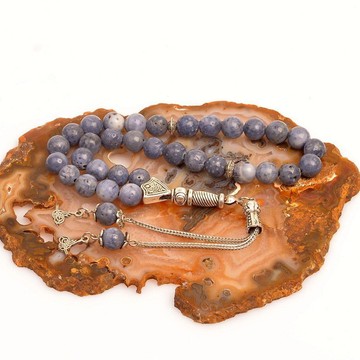
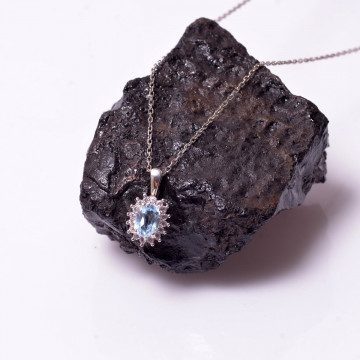
How are natural stones formed? The answer differs from one type of stone to the next. So why not learn the story behind these stones and fall in love with their beauty all over again?
Ready? Let the journey into the mysterious world of natural stones begin!
A natural stone is a stone that forms on its own in nature and is then processed to make it suitable for use. That said, not every stone that occurs naturally in the wild falls into this category.
To be considered 'natural,' a stone must have its own luster, beauty, brittleness, and a range of distinctive properties.
Natural and precious stones are believed to draw in the negative energy around them and trap it within. In this way, they are said to help protect the environment and support sustainability. When people carry these stones on them, they are thought to show the same effect and keep negative energies away. This is traditionally associated with helping to preserve health and reduce stress.
Have you ever dreamed of living in a house made of stone? If you own jewelry set with ornamental stones, how do they make you feel?
So how did these stones come to be? Have you ever thought about it? Who knows what news from the past they have carried to humanity?
Stones, one of the oldest materials for adornment and construction, win everyone over with their looks. So let us listen to the story, full of secrets, of the stones on which art and architecture were built.
The formation process of natural stones, which reaches far back in time, is linked to metamorphism. Put briefly, this means high heat and pressure.
These stones take millions of years to form. Moreover, each natural stone arises in different rocks and through different minerals. For this reason, every natural stone has its own properties.
Many other factors also play a role in the formation of natural stones. For example:
- The drying up of seas,
- Magmatic movements,
- Oxidation,
- Reactions between heat and cold,
- Humidity in the air, and more.
Suppose a natural stone ran out. Tens of thousands of centuries would have to pass before a new one could form. In that case, people could only get that stone back by producing it in a laboratory. Imitation stones, however, will never take the place of the original ones.
In short, the theory explains how stones formed as follows:
- Planets and galaxies are made of helium and hydrogen.
- As the Earth continues to exist in space, it collides with a mass and a large piece breaks off. (This piece is thought to be the Moon.)
- The crusts of the Earth and the Moon turn into a molten, red-hot liquid.
- These celestial bodies begin to cool over the years through natural motion.
- In this way, primitive rocks emerge.
- The lithosphere forms the outer layer of the Earth.
- Falling meteorites, temperature changes, earthquakes, and volcanic lava flows break the surface into pieces.
- Volcanic gases rise to the surface along with the lava.
- Nitrogen, carbon dioxide, and water vapor form our atmosphere around the Earth.
- Under the influence of these natural events, the formation of natural stones gradually takes shape.
- Atoms combine into minerals. Minerals in turn come together to form stones.
Travertine, pebbles, and limestone are examples of sedimentary rocks. They form through the breakdown and erosion of stones that already exist. Water and wind also play an active role in how these stones form.
Deposits that collect in places such as lakes and seas harden over time. As a result, they turn to stone again and form rocks. Sedimentary stones contain fossils. Many minerals and fuels, from gold to coal and from diamonds to iron and petroleum, are obtained from these stones.
How do natural stones form? In answering this question, we also want to talk about how metamorphic stones form. Marble, schist, gneiss, and similar stones are a few of them.
The deposits that make up the base of these stones change under the influence of heat and pressure. As a result, metamorphic stones emerge.
Andesite, basalt, and granite are some of these stones. They are also called 'eruptive stones.' They form when magma crystallizes, cools, and then solidifies.
The History of Natural Stones
The history of these stones goes back to Antiquity. Some were discovered only recently.
Quartz crystals are among the first precious stones mentioned in written sources. For this reason, it is possible to say that the first stones ever used belonged to the quartz family.
Throughout history, natural stones have been used for ritual, protection, healing, ceremony, meditation, and various mystical purposes. Many precious stones were given mythological meanings and linked with gods and goddesses.
An Overall Look at Natural Stones
How do natural stones form? As we look into this question, we see what an old place stones hold in our lives. Using stones, humankind has built temples, palaces, castles, and historic monuments.
People also carved idols and statues out of stone and chose to worship them. Thanks to stones, they made many tools and utensils, and so managed to sustain their lives.
Every stone tells us about the natural environment of our past and sheds light on geological history. If you want to give such great value a place in every area of your life, you can add a new dimension to your style by choosing our natural stone products.