Natural Stone Map of Turkey
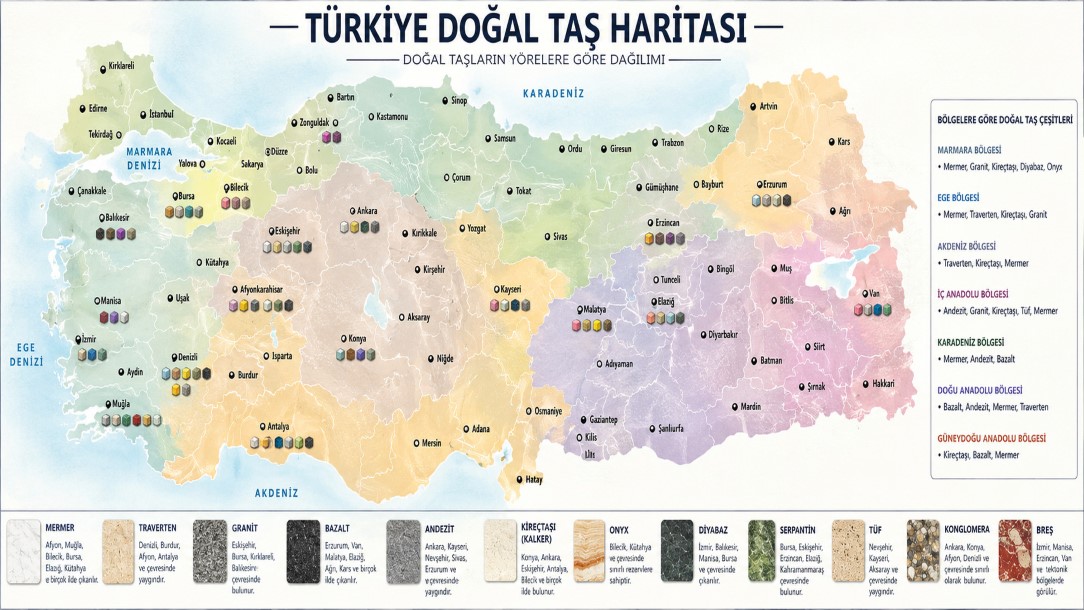
A natural stone map of Turkey shows how the country's geological diversity is spread across its regions and where each type of natural stone is concentrated. Because Turkey sits on the Alpine-Himalayan fold belt, rocks of different ages and origins are found throughout the country. The map also shows that marble, travertine, granite, basalt and limestone do not form in just one region but in many different parts of the country. This raises production capacity and has helped Turkey reach a strong position in the global natural stone industry. Studies of the map also make the link clear between the regions where stones are quarried and the ways those stones are used.
Related content: How are natural stones used?
Where Are Natural Stones Found in Turkey?
Natural stone resources are found in almost every region of Turkey, but some regions hold larger reserves. The Aegean Region is one of the most important centers. Provinces such as Afyon, Denizli and Mugla have dense deposits of high-quality marble and travertine. The geology here suits stone formation well, so the color and texture of the stones meet world standards. In the Central Anatolia Region, Eskisehir and its surroundings have strong potential for granite and other hard rocks. In the Eastern Anatolia Region, volcanic stones such as basalt and andesite are common around Elazig. This wide distribution also explains why different regions of Turkey specialize in different types of stone.
Related content: The strongest natural stones
Natural Stones in Turkey
Turkey has a wide and rich variety of natural stones. This variety comes from the long and complex geological history of the country. Marble, travertine, granite, basalt, andesite, limestone, quartzite and onyx are among them, and each has different physical properties. Marble is widely preferred in interior and exterior architecture for its crystalline structure and appearance. Travertine stands out on decorative surfaces and floor coverings because of its porous structure. Granite is chosen where long-lasting use is needed because of its high hardness. Volcanic stones such as basalt and andesite are often used in infrastructure projects because they are durable. Thanks to this variety, Turkey's natural stones are in strong demand in both local and international markets.
Turkey, a Paradise of Natural Stone
"Turkey, a paradise of natural stone" describes how strong the country's position is worldwide in reserve variety and quality. The phrase comes mainly from the high aesthetic and technical standards of the marble, travertine and other natural stones found in different regions of Turkey. Turkey's natural stone quarries offer a wide range of colors and patterns. They also hold an important share of the world market in production capacity. One more reason the phrase comes to mind is that these stones are used not only in construction but also widely in architectural design and decoration.
Natural Stones Quarried in Turkey
The natural stones quarried in Turkey make up a very long list, and each formed through a different geological process. Marble and travertine are the best known. Granite, basalt, andesite, limestone, quartzite and onyx are also widely quarried. Each has its own hardness, color range and uses. Travertine, for example, is quarried mostly around Denizli, while high-quality marble comes from regions such as Afyon and Mugla. Basalt and andesite form large reserves in Eastern and Central Anatolia, where volcanic activity shaped the land. Thanks to this variety, the natural stones quarried in Turkey create great economic value in both the domestic market and exports.
Distribution of Turkey's Natural Stones by Region
Looking at how Turkey's natural stones are distributed by region, each region concentrates on different stone types because of its own geology. The Aegean Region is one of the richest areas for marble and travertine, and provinces such as Afyon, Denizli and Mugla are production centers known worldwide. The Central Anatolia Region has strong potential for granite and other hard rocks, with Eskisehir and its surroundings standing out. Volcanic stones such as basalt and andesite are common in the Eastern Anatolia Region. Granite and limestone reserves stand out in the Marmara Region, while travertine and limestone are dense in the Mediterranean Region. Together, this distribution shows the geological diversity of Turkey and how that diversity turns into economic value.
Marble
Marble is one of the most widely quarried and most valuable natural stones in Turkey. It is a metamorphic rock formed when limestone recrystallizes under high pressure and temperature. Turkey ranks near the top of the world in marble reserves. The Afyon, Mugla, Bursa, Bilecik and Elazig regions stand out for high-quality marble. Marble from these regions varies widely in color and vein pattern, and it comes in white, gray, beige, black and green tones. Marble is so common in Turkey because the geology suits it and because the natural formation processes, which took millions of years, covered wide areas.
Travertine
Travertine is a sedimentary natural stone formed when calcium carbonate carried by hot springs settles out of the water. Turkey is considered one of the world's most important production centers for it. The Pamukkale travertines in the Denizli region are famous worldwide, both as a natural formation and for production. Travertine in Turkey is known for its light color and comes in white, cream and light brown tones. It is porous and lightweight, and it looks good. For these reasons it is often chosen for floor coverings, wall applications and decorative architectural projects.
Granite
Granite is a very hard and durable natural stone of igneous origin. In Turkey it is quarried mainly in Central Anatolia and parts of the Marmara Region. Granite is made up of quartz, feldspar and mica minerals, and this structure makes it extremely resistant to wear. Granite deposits in Turkey are concentrated around Eskisehir. The stone is used for kitchen countertops, exterior cladding and high-traffic areas because it lasts a long time.
Basalt
Basalt is a dark volcanic rock. In Turkey it is common mainly in Eastern and Central Anatolia. It forms when lava cools quickly, and the result is a very hard and dense stone. For this reason it is often chosen for road building, paving stones, infrastructure projects and areas that carry heavy loads. Basalt reserves in Turkey spread over wide areas in regions with a volcanic past, which adds to the stone's economic value.
Andesite
Andesite is a medium-hard natural stone formed by volcanic activity. In Turkey it is common mainly in Ankara, Kayseri and Eastern Anatolia. Known for its gray and light gray tones, andesite is durable and has a non-slip surface. It is often used in urban landscaping, paving stones and architectural facade cladding. Andesite production in Turkey is spread along the volcanic belts, which gives the stone a wide range of uses.
Limestone
Limestone is a sedimentary rock found in many regions of Turkey. It has large reserves in the Mediterranean, Marmara and Central Anatolia regions. It is one of the basic materials of the construction industry and an important raw material in cement production. Limestone formations in Turkey are the result of long accumulation in marine environments. This is why the stone is both widespread and economically important.
Quartzite
Quartzite is a very hard metamorphic rock. In Turkey it is found in limited but high-quality reserves. It forms when quartz sandstone transforms under high pressure, and it is very durable. In Turkey, quartzite is chosen for decorative cladding, flooring and special architectural projects because it offers both an attractive look and long service life.
Onyx
Onyx is one of the rare natural stones, known for its translucent and attractive look. In Turkey it is quarried mainly in and around Bilecik. Because light passes through it, it is used in decorative lighting elements and luxury interior design. Onyx reserves in Turkey are more limited than those of other stones, but onyx is still considered a very valuable natural stone because of its high aesthetic value.
Calcareous Limestone (Kalker)
Kalker is a widespread sedimentary rock in Turkey, found mostly in the Central Anatolia, Mediterranean and Marmara regions. The areas around Ankara, Konya and Eskisehir are rich in kalker deposits, and the kalker there is the main raw material of the cement industry. Marine-origin kalker formations are also common in the Mediterranean Region, in and around Antalya. In the Marmara Region, Bilecik and its surroundings stand out for kalker reserves. Kalker is so widespread in Turkey because seas covered large areas of land in past geological periods.
Diabase
Diabase is a hard igneous natural stone concentrated mainly in the Marmara and Aegean regions of Turkey. The best-known quarrying areas are around Izmir, Balikesir, Manisa and Bursa. Diabase formations in these regions mostly result from ancient volcanic activity. The stone is fine-grained and hard, which makes it well suited to road surfacing, paving stones and outdoor applications. Diabase reserves in Turkey are concentrated along the northwestern Anatolian line, and this is why the stone is widely used in infrastructure projects.
Serpentine
Serpentine is a metamorphic rock common in regions of Turkey with ophiolite belts. The most important quarrying areas are around Bursa, Eskisehir, Elazig, Erzincan and Kahramanmaras. Serpentine stands out with its greenish and dark tones. It usually forms in mountainous and tectonically active regions, so it makes up different reserve areas in the eastern and western belts of Turkey. It is also used in architecture for its decorative qualities, especially as a cladding and ornamental stone.
Tuff
Tuff is a volcanic rock found most densely in the Central Anatolia Region of Turkey, especially around Nevsehir, Urgup, Avanos and Kayseri. The tuff formations of Cappadocia are famous worldwide as both a natural landscape and the main material of historic buildings. Tuff is porous and easy to work. Throughout history it has been ideal for carved structures and dwellings, and today it is used in decorative architectural projects. Tuff reserves in Turkey cover wide areas of the Central Anatolian belt, where volcanic eruptions were frequent.
Conglomerate
Conglomerate is a sedimentary rock seen in the Central Anatolia, Aegean and, to a lesser extent, Marmara regions of Turkey. It is quarried in certain areas around Ankara, Konya, Afyon and Denizli. It forms when rounded pebbles are bound together by a natural cement, usually in old riverbeds and alluvial areas. Conglomerate reserves in Turkey are not very large. Even so, the stone is chosen for decorative uses and landscaping because of its appearance.
Breccia
Breccia is a natural stone made of angular rock fragments. In Turkey it forms mainly near fault lines where tectonic movement is intense. The most important reserve areas are the inland parts of the Aegean Region, some fault zones of Central Anatolia and tectonically active areas of Eastern Anatolia. Breccia formations can be found around Izmir, Manisa, Erzincan and Van. The stone's most distinctive feature is that fragments of different colors and rocks join together like a natural mosaic. That is why it is used in decorative architectural projects and cladding work.
Frequently Asked Questions About Where Natural Stones Are Found in Turkey
Which natural stone is quarried the most in Turkey?
Marble is the most quarried natural stone in Turkey. It has very large reserves across the country, and it is easier to work than many other stones. Marble is quarried heavily in the Aegean, Marmara and Eastern Anatolia regions, and provinces such as Afyon, Mugla, Bilecik and Elazig are among the production centers. Turkish marble comes in a wide range of colors, vein patterns and hardness levels. White, gray, beige, black and green tones are in high demand on the world market. This makes marble the most preferred natural stone in both interior architecture and exterior facades, and it adds significantly to the country's export income.
Why is Turkey rich in natural stone?
The main reason is that Turkey lies on the Alpine-Himalayan fold belt, one of the most tectonically active zones in the world. Because of this position, metamorphic, igneous and sedimentary rocks formed in different geological periods exist side by side. Millions of years of crustal movement, volcanic activity and marine deposition have produced a great variety of stone formations across the country. As a result, metamorphic stones like marble, volcanic stones like basalt and sedimentary stones like limestone all cover wide areas at the same time.
Where is travertine found the most in Turkey?
Travertine is found most densely in and around Denizli, and the region is known worldwide for the Pamukkale travertines. Travertine forms over time as calcium carbonate carried by hot springs settles out. In Turkey this process is very active along the Denizli, Burdur and Afyon line. The geothermal resources of the region keep feeding travertine formation and create wide, white, porous rock structures. These travertines have high value both as natural beauty and as building material, and they hold an important place in Turkey's natural stone exports.
In which regions of Turkey is granite quarried?
Granite is an igneous natural stone found in more limited areas of Turkey. The most important reserves are in the Central Anatolia and Marmara regions. Eskisehir, Bursa, Kirklareli and their surroundings are among the areas with intense granite quarrying. Granite forms from magma that cools slowly deep in the earth's crust, so it is very hard, dense and durable. Because of these qualities, granite quarried in Turkey is preferred for exterior cladding, kitchen countertops, stair steps and heavy-use areas, and it is regarded as a long-lasting building material.
What are the uses of basalt?
Basalt is one of the most important volcanic rocks used in infrastructure and road projects in Turkey. Large basalt reserves exist in Eastern and Central Anatolia, especially around Erzurum, Van and Malatya. The stone forms when lava cools quickly, so it is very hard and dense. Because of this, basalt is widely used for road surfaces, paving stones, railway ballast and floors that carry heavy loads. Its durability also makes it a common choice for urban landscaping and outdoor projects.
Where is limestone (kalker) quarried in Turkey, and how is it used?
Limestone (kalker) is a sedimentary rock spread over wide areas of Turkey. It is quarried most heavily in the Central Anatolia, Mediterranean and Marmara regions. The areas around Ankara, Konya, Eskisehir, Antalya and Bilecik stand out for limestone deposits. This marine-origin rock is rich in calcium carbonate, so it is used as a basic raw material in cement and lime production. It is also used as fill material and as a basic building element in construction. Its large reserves give it an important place in Turkey's industrial stone production.
In which regions of Turkey is andesite found?
Andesite is common in Central and Eastern Anatolia. It is a volcanic stone, so it spreads over wide areas along old volcanic belts. The areas around Ankara, Kayseri and Nevsehir are the best-known andesite quarrying areas. It is durable and has a non-slip surface. For this reason it is used heavily in urban landscaping, paving stones, square paving and architectural facade work. The size of Turkey's andesite reserves keeps the stone in steady demand for infrastructure and urban design projects.
Where is onyx found in Turkey, and why is it valuable?
Onyx is a translucent natural stone with high decorative value, quarried mostly in and around Bilecik. Its most important feature is that it lets some light through, which creates very special visual effects. Onyx reserves in Turkey are more limited than those of marble and travertine, and this scarcity adds to the stone's value. It is generally used in luxury interior projects, decorative wall cladding and backlit designs, and it is chosen for special projects because of its visual impact.
Where is tuff common in Turkey?
Tuff is most common in the Central Anatolia Region, especially around Nevsehir, Urgup, Avanos and Kayseri. It forms when ash and fine material from volcanic eruptions compress over time. The stone is porous and soft, so it is easy to work. In Cappadocia, tuff formations make up the base of the natural landscape. Throughout history they have also been used for rock-carved buildings, dwellings and places of worship. Today tuff is an important part of decorative architecture and tourist buildings.
In which regions of Turkey is serpentine quarried?
Serpentine is widely quarried in the mountainous and tectonically active regions of Turkey where ophiolite belts occur. The areas around Bursa, Eskisehir, Erzincan, Elazig and Kahramanmaras are important serpentine reserve areas. This metamorphic stone has greenish and dark tones, and it usually appears in regions linked to mountain-building processes. In Turkey, serpentine is used as a decorative cladding stone. Its natural look makes it a choice for aesthetic purposes in both interior and exterior architecture.